
The Quest for Perfect Slumber: Top Sleep Trackers Reviewed
Discover the best sleep trackers of 2025, blending advanced technology with comfort to unlock deep insights into your sleep quality and rhythms.
Sleep, that elusive elixir of life, remains a mystery for many. In 2025, understanding its intricate patterns is no longer confined to sleep labs; it's brought home by sophisticated trackers promising insights into our nightly journeys. Yet, with a dizzying array of devices claiming accuracy, choosing the right sentinel for your slumber feels like navigating a dream itself. From rings whispering secrets to headbands reading minds, the landscape of sleep technology offers diverse paths to understanding rest, each with its own strengths and quirks. The quest isn't just for duration, but for depth, quality, and the hidden rhythms of the night. 🛌✨
The Discreet Observer: Oura Ring Generation 3
Eschewing the wrist entirely, the Oura Ring Generation 3 slips onto your finger like a piece of futuristic jewelry. Within its sleek titanium band lies a powerhouse of sensors monitoring blood oxygen, body temperature, heart rate, and crucially, sleep architecture. It doesn't merely clock hours; it dissects the night into light sleep, deep sleep, and REM sleep phases. 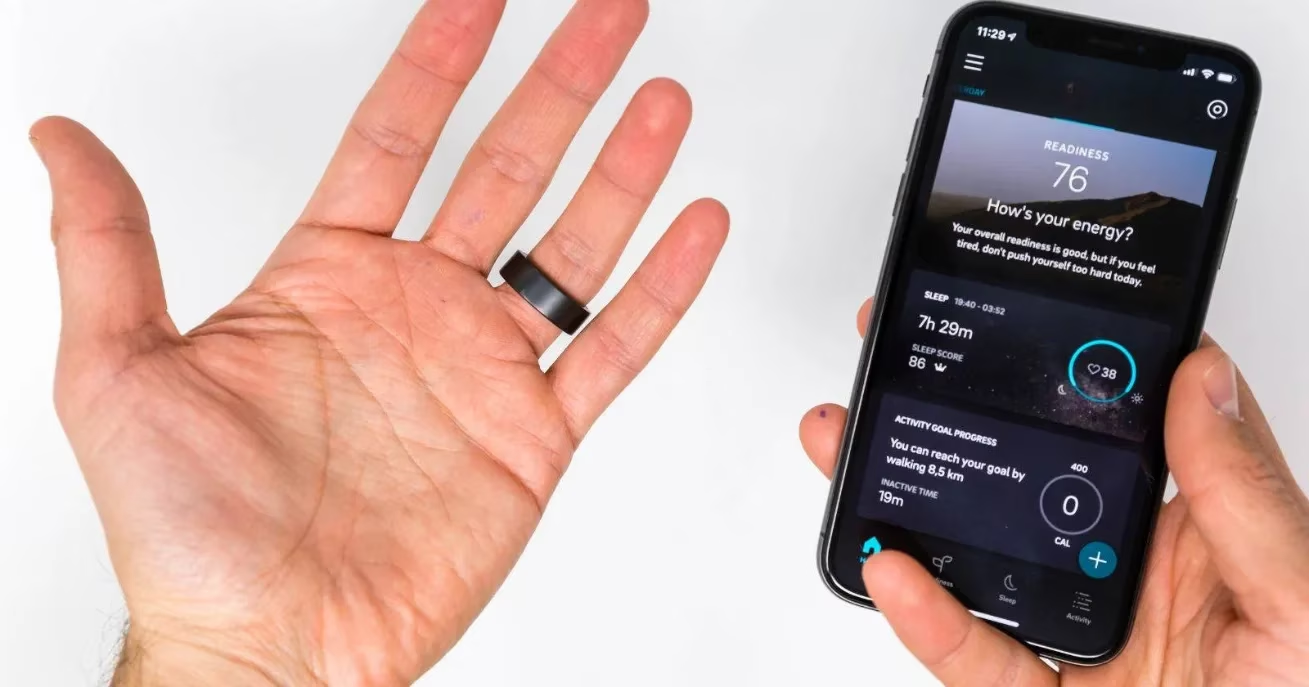
-
Accuracy: Independent testing by Illuminate Labs suggests its sleep stage detection accuracy sits around 70-80%. While not the absolute pinnacle, this reliability makes it a strong contender, especially for those valuing subtlety and continuous wear. Its focus on circadian rhythms and recovery metrics provides a holistic view beyond just sleep.
-
Experience: Wearing it feels natural, almost forgettable, making long-term tracking effortless.
The Coach's Companion: Whoop 4.0
The Whoop 4.0 wristband adopts a minimalist, screen-free philosophy. This unobtrusive band prioritizes strain, recovery, and sleep, deliberately avoiding step counts or calorie burn. Its core mission is understanding how well your body recuperates overnight.
-
Accuracy: Span Health reports its accuracy for detecting deep and REM sleep hovers near 70%. While figures for wakefulness and light sleep are less publicly defined, its focus on actionable recovery data resonates with athletes and performance enthusiasts.
-
Model: Access requires a membership subscription (12 or 24 months upfront), though a free month trial offers a risk-free introduction. It’s less a sleep tracker, more a physiological readiness monitor.
The Smartwatch Sovereign: Apple Watch Series 8
The Series 8, Apple's flagship wearable (as of late 2022, still widely used in 2025), integrates comprehensive sleep tracking into its smartwatch ecosystem. Utilizing its accelerometer and advanced algorithms in watchOS 9, it tracks REM, Core (Apple's term for light sleep), and Deep sleep stages.
-
Accuracy: Sleepopolis indicates newer Apple Watches achieve roughly 80% accuracy for deep and REM sleep identification – a notable figure in the consumer wearables space. Its integration with the broader Apple Health ecosystem is a major draw.
-
Consideration: Premium pricing (starting well over $400) positions it as an investment, best suited for those already embedded in the Apple universe seeking a multifunctional health hub.
The Undercover Analyst: Withings Sleep
Breaking the mold entirely, the Withings Sleep isn't worn; it resides discreetly under your mattress. This innovative pad detects movement, heart rate, and snoring to analyze sleep phases (light, deep, REM) and overall duration.
-
Value Champion: Its standout feature is affordability, often available under $100. This makes advanced sleep staging accessible without a hefty price tag.
-
Accuracy Nuance: Concrete accuracy figures per sleep stage are scarce. While praised by many for comfort and convenience, some users report limitations, particularly in accurately detecting short naps. It’s ideal for those prioritizing non-invasive monitoring on a budget.
The Brainwave Interpreter: Muse S Headband
The Muse S ventures where others don't: directly onto your head. This EEG-equipped headband tracks brain activity, offering unparalleled insights into sleep stages (wake, light, deep, REM) and even sleep positions.
-
Precision Leader: Muse claims an impressive 86% sleep stage identification accuracy, validated by neurotechnology firm InteraXon. This positions it as potentially the most accurate consumer device for dissecting sleep architecture.
-
Trade-off: The necessity of wearing a headband can be intrusive, especially for light sleepers sensitive to added sensation. It’s a dedicated tool for those deeply serious about optimizing sleep quality, willing to trade some comfort for depth of data.
The Biometric Specialist: Biostrap Evo
Similar in form to the Whoop (a simple, screenless wristband), the Biostrap Evo focuses intensely on physiological signals: heart rate, heart rate variability (HRV), respiratory rate, and blood oxygen. It also tracks sleep positions.
-
Unique Gap: Notably, it currently lacks dedicated REM sleep tracking, a significant omission compared to rivals. Its strength lies in detailed autonomic nervous system metrics during sleep rather than comprehensive sleep staging.
-
Focus: Best suited for users fascinated by the raw biometrics of rest rather than a full sleep stage breakdown.
People Also Ask: Common Sleep Tracker Queries
-
Are expensive sleep trackers always more accurate? Not necessarily. While some premium devices (like Muse S) boast high accuracy, design and sensor type (EEG vs. movement/HR) play a huge role. A well-tuned under-mattress sensor (Withings) can outperform a basic wristband.
-
How do I know if my sleep tracker data is reliable? Consistency is key. Look for patterns over time rather than single-night data. Correlate how you feel upon waking with the data. High accuracy claims (like Muse's 86%) based on third-party validation offer more confidence.
-
Can sleep trackers help diagnose sleep disorders? Consumer devices are not diagnostic tools. They provide valuable trends and insights but cannot replace a professional sleep study (polysomnography) for conditions like sleep apnea or narcolepsy. Use them for awareness, not diagnosis.
-
Do trackers work for naps? Performance varies wildly. Short naps are notoriously difficult for most trackers (especially movement-based ones like Withings or basic wristbands) to detect and stage accurately. Devices focusing on physiological signals (HR, HRV) might fare slightly better.
-
Is wearing something to bed disruptive? This is highly personal. Rings (Oura) and under-mattress pads (Withings) are least intrusive. Wristbands (Whoop, Biostrap) are generally tolerable. Headbands (Muse) are the most likely to cause initial discomfort, especially for sensitive sleepers.
A Glimpse into the Future: Beyond the Dashboard
Looking beyond the current dashboard of heart rates and sleep stages, one envisions a future where sleep trackers evolve into true sleep optimizers. Imagine AI that doesn't just report your REM deficit but actively curates your environment to gently encourage it – adjusting room temperature minutely as you enter lighter sleep phases, or playing ultra-low-frequency soundwaves calibrated to your brainwaves to deepen slow-wave sleep. The next frontier lies in closed-loop systems: devices that seamlessly integrate with smart home ecosystems to dynamically alter lighting, sound, and climate based on real-time sleep physiology, turning the bedroom into a responsive cocoon. Furthermore, the integration of more sophisticated biomarkers – perhaps subtle cortisol levels or detailed gut-brain axis signals gleaned non-invasively – could paint a near-complete picture of nocturnal restoration, moving us from passive observation to active, personalized sleep enhancement. The goal isn't just more data, but genuinely better sleep, orchestrated silently by technology attuned to our individual biological symphonies. 🚀
Choosing Your Nighttime Sentinel
Selecting the most accurate sleep tracker hinges on aligning technology with personal need and comfort:
| Feature | Oura Ring | Whoop 4.0 | Apple Watch S8 | Withings Sleep | Muse S | Biostrap Evo |
|---|---|---|---|---|---|---|
| Worn Location | Finger | Wrist | Wrist | Under Mattress | Head | Wrist |
| Key Metrics | Temp, HR, SpO2, Sleep Staging | HR, HRV, Temp, Sleep Staging | HR, Accel, Sleep Staging (REM, Core, Deep) | Movement, HR, Snoring, Sleep Staging | EEG, Sleep Stages, Position | HR, HRV, RR, SpO2, Position |
| REM Tracking | ✅ | ✅ | ✅ | ✅ | ✅ | ❌ |
| Accuracy (Est.) | 70-80% | ~70% (Deep/REM) | ~80% (Deep/REM) | Variable | 86% | N/A (No REM) |
| Price Point | $$$ | Subscription | $$$$ | $ | $$$ | $$$ |
| Best For | Discreet continuous monitoring | Recovery-focused athletes | Apple ecosystem users | Budget, non-wearable | Highest accuracy seekers | Detailed biometrics (non-REM) |
Ultimately, the 'most accurate' tracker is the one you'll wear consistently and whose insights you find actionable. Whether it's the subtle whisper of the Oura, the brainwave insights of the Muse, or the under-mattress vigilance of Withings, each device offers a unique lens into the vital world of sleep. Prioritize comfort, the specific data you crave, and your budget to find your perfect nocturnal companion. May your journey lead to sweeter, more understood dreams. 🌙